By: Ari Morgan

I skipped the page.
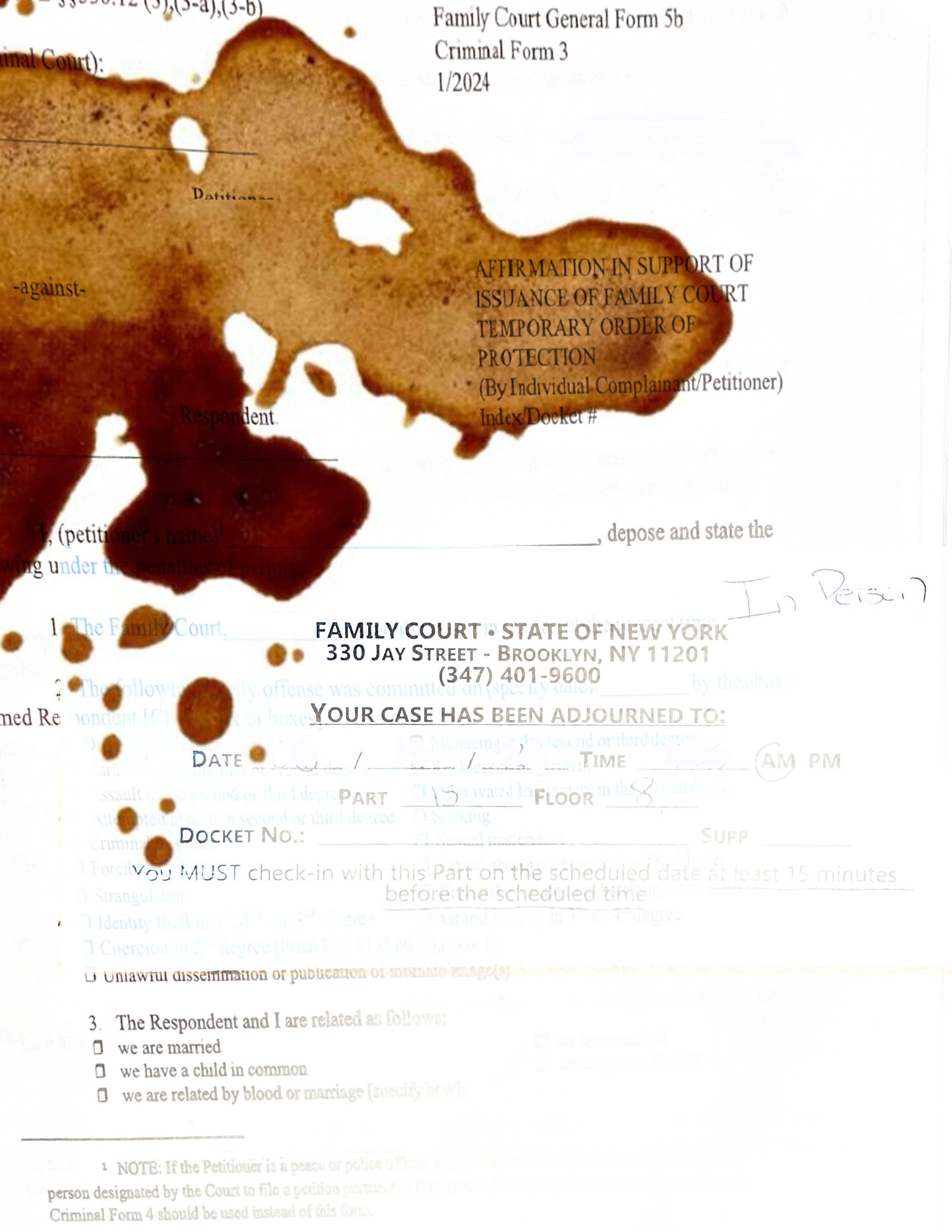
Not accidentally — not really. My hand moved with suspicious confidence, flipping past the questions that clearly required… emotional labor. Boxes that wanted evidence. Lines that wanted me to turn my life into bullet points.
Did he have a gun?
Did he threaten you?
Did he hurt you?
When. Where. How.
I suddenly became very interested in the next page. Anything but that one.
The clerk slid the papers back to me with the kind of calm that suggested she had seen this exact brand of avoidance before.
“You missed a page.”
Missed. Like I forgot to carry a one in math. Like I didn’t intentionally dodge the most devastating part of the form.
I looked at my friend, who was doing me the enormous favor of helping me navigate this whole process. A corporate lawyer. Contracts, deals, clean lines. Not… this. Not feelings with footnotes. Not trauma in paragraph form.
She looked at me, steady, unfazed, and said, “Speak your truth, girl.”
And I almost laughed.
Because what do you mean, speak my truth? Like it’s just… sitting there, ready? Like I haven’t been strategically avoiding it for years? Like I haven’t built a whole personality around being fine?
But there it was: permission. Casual. Unceremonious. No paperwork required.
And somehow, that made it heavier.
Because I realized, sitting there under flickering fluorescent lights that made everyone look a little haunted, that I had been waiting for someone to officially authorize my story. A stamp. A nod. A “you may begin.”
But there was no ceremony. No announcer. No one stepping in to narrate on my behalf.
It was just me, a pen, and a page I couldn’t skip anymore.
So I went back.
And I wrote.
I wrote slowly at first, gingerly, like I was trying not to scare the truth away. Then faster, because once it starts, it doesn’t really stop. I wrote things I had edited out of my own memory. Things I had minimized, reframed, joked about at dinner like they were quirky anecdotes instead of warnings I ignored.
And occasionally, I paused. Not just because it hurt, but because part of me still felt like I was going to get in trouble. Like someone was going to tap my shoulder and say, “Actually, you’re not allowed to say that. That’s too much. That’s too real. That makes other people uncomfortable.”
But no one did. Just the low hum of the AC, babies in strollers pushed by young mothers, and officers in ill-fitting uniforms marching across the room.
But I kept going.
And somewhere between answering “when” and “where,” I understood something that was both devastating and, in a strange way, a little funny:
No one was ever going to grant me permission to tell what happened to me.
Not him. Not the court. Not the universe sending me a neatly typed invitation that said, “Now is a great time to process your trauma.”
If I wanted safety, if I wanted protection, if I wanted to tell the truth without immediately softening it for someone else’s comfort, I and only I had to allow it.
I would have preferred a formal approval process. A committee, maybe. A short delay. A “we’ll circle back.”
But no.
It was just me, realizing that permission is sometimes less about being given access and more about deciding you’re done asking.
So I finished the page.
Hand slightly shaking. Spirit slightly cracked open. But done.
And in that quiet, bureaucratic moment, between a clerk’s pen and a stamped document, I stopped waiting for someone to tell me I could speak.
And became the one who says, with a little fear and a little audacity:
You may begin.
Deja un comentario