By: Carson Jane Robles

Pale-faced with dark circles painted beneath my eyes, I stare daggers at the reflection across from me. My refusal to ruin painstakingly-applied liquid eyeliner serves as a fragile dam against whitewater tears. I am trying to apply a deep, vampiric lip for a Halloween event at Three Dollar Bill. Instead, my mouth is a clown’s mouth: red, ugly, laughable.
I crumple to the hardwood floor and glare at the cobwebs on the ceiling.
“Sister! Are you almost ready?” my roommate calls out from across the apartment. She is younger than me with different parents but she is my older sister.
“No,” I croak.
She appears over me, an angel in sequins. “Sister. What’s wrong?”
The dam breaks and I sob, “I fucking hate lip liner.”
My sister rescues my lips (my pencil was too dull and I overlined the bottom lip) and the night. We dance like animals and come home like stupid drunks, splitting a cab and a Klondike bar.
When my sister tells me a year later that she has booked a nine-month-long gig on the Princess Cruise Line and will be leaving before the end of the month, I think of this Halloween. Of course I am proud of her — we do lots of tequila shots and throw a goodbye party at Carousel to celebrate — but I am selfish and will miss her womanly expertise on makeup and boys.
Enter Carrie, Miranda, Charlotte, and Samantha. I fill the sudden quietude of my apartment with the voices of my four, new, feminine guideposts. Carrie enables my online shopping addiction and penchant for designer shoes, Miranda justifies my newfound misandry, and Charlotte combats that misandry by convincing me to kiss un-handsome boys.
Samantha reminds me of my sister. She gets what she wants and who she wants. I am newly single and turn to Samantha for advice. Just one and a half years out from my first two milligram dose of estradiol, the effects have finally started to set in. Men in bars are buying me drinks and asking me where I’m from. With the approval of Samantha, I have even let a few of them kiss me on the neck and chest in the public solitude of strobe-lit nightclubs.
Once they ask me to accompany them to the bathroom or their apartment or a hotel room, I cut the line. I offer a prudish excuse and fake phone number, and tell them to buy me dinner sometime.
I feel no guilt for this, and neither would Samantha, I think. Her blasé attitude towards the male sex inspires my recklessness. I get what I want, and I leave!
But I am not my older sister Samantha, try as I may. Samantha has sex with these men; I do not. This is because I am a transgender woman; Samantha is not.
Still, our sisterhood transcends the nuances of real life. I project myself onto her, though my lived reality may never intersect with hers.
That is, until Season 3, Episode 18 of Sex and the City, when we meet outside of her apartment.
In “Cock a Doodle Doo,” Carrie and Samantha combat insomnia as careless animals scream outside their respective windows in the dead of night. Carrie’s enemy is a flock of roosters from the neighboring animal hospital. Samantha is kept up by another group of cocks: a trio of tipsy “pre-op transsexuals” (as Carrie’s voiceover dubs them).
Destiny, Chyna, and Jo (without an E) are archetypal versions of the late nineties/early aughts transsexual. Hedonistic, ostentatious, and muscular, these women operate as the between-two-genders version of the transgender woman. Today, a crass depiction of the transgender woman depicts her as a man pretending to be a woman. Sex and the City is not so sophisticated, painting instead the portrait of a freak of nature; a “half-man, half-woman,” the episode calls her.
Sex and the City’s transsexual is pieces of man and woman Frankensteined together. She evokes the transsexual that Susan Stryker posits in her essay, “My Words to Victor Frankenstein Above the Village of Chamounix,” published six years earlier: “I will say this as bluntly as I know how: I am a transsexual, and therefore I am a monster” (246).
Stryker’s transsexual is one I have always struggled with. I reject her line of reasoning; I reject monstrosity. The last four years of my transition I have spent rejecting monstrosity.
The subtle lift in my voice, the giddy laugh I offer to men, the pink on my bathrobe, my water bottle, my curtains, the Christian Dior Forever Glow foundation I cannot afford, the Vivienne Westwood blouse I really cannot afford, the obsession with Julia Roberts romcoms, the cute corporate job where I wear cute corporate outfits, and the binge watch of Sex and the City — these are all the ways I reject monstrosity.
Samantha is generous to her neighbors at first. She approaches the transsexuals with the tact of a marketing executive, offering a wink and a nudge, and then politely requesting they shut the hell up. The ladies compliment her shoes (“fierceee”) and move further up the block. If I turn the episode off here, I can almost imagine that Samantha and I see each other; we wear the same heels and fuck the same men.
Cut to breakfast with the core four and Samantha is complaining about the freaks outside her window. The ladies have a good laugh and lob a couple easy punchlines about cocks and holes and chopping things off. All things considered, it is a tame lashing for a 2000s comedy bit about transsexuals.
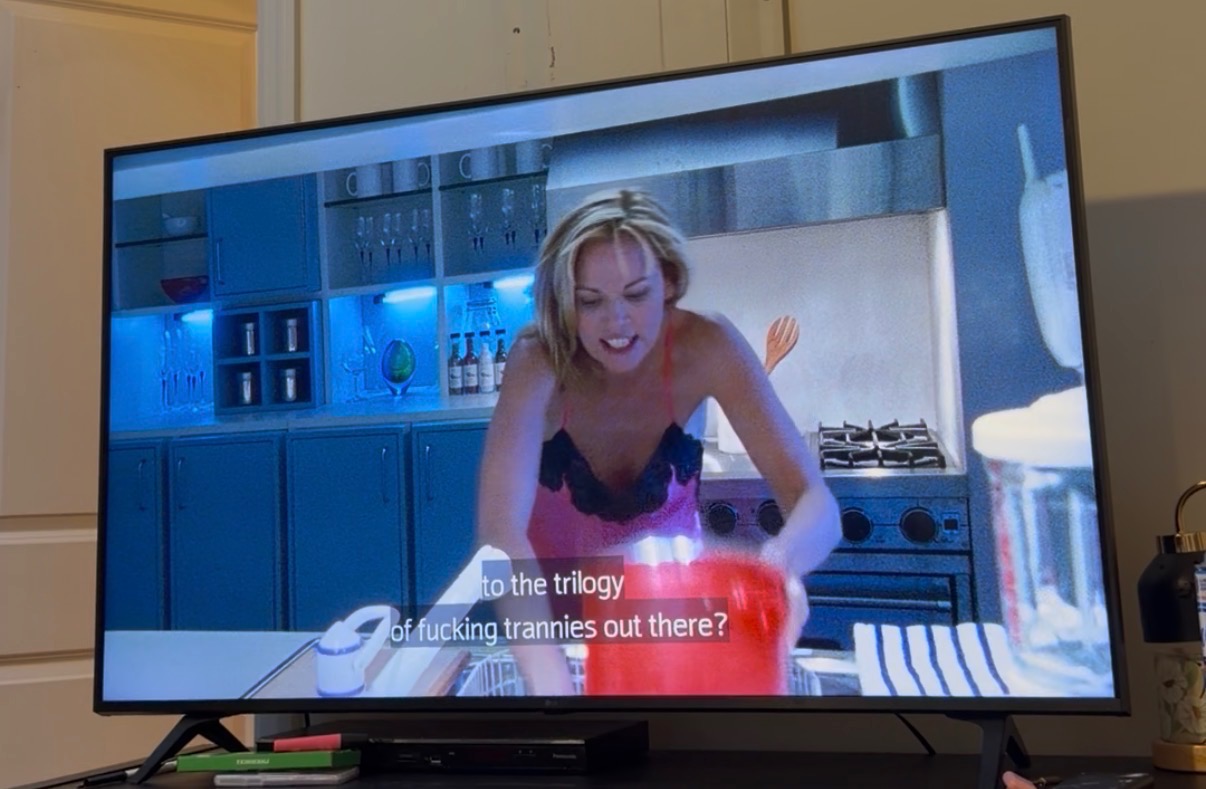
But things go sour the next day when, instead of disturbing Samantha’s sleep, the transsexuals return and interrupt her sex. Ms. Jones sheds her public relations persona to unveil a primal rage. Here, she delivers my favorite line of the series: “$7,000 a month and I have to put up with a trilogy of fucking trannies down there? I don’t fucking think so!”
Samantha pours a pot of water over Destiny’s head, revealing a bald, enraged woman below. As Samantha cackles, Destiny curses and swears revenge.
This grotesque visage of Destiny recalls Stryker’s transsexual monster. In her essay, Susan Stryker identifies “transsexual rage” as a natural antecedent to the innate transsexual monstrosity. She posits herself — and all transsexuals — as Frankenstein’s monster, both for her mutated body and the social ostracization that has followed. Like Frankenstein’s monster, Stryker embodies rage as a response:
Transgender rage is a queer fury, an emotional response to conditions in which it becomes imperative to take up, for the sake of one’s own continued survival as a subject, a set of practices that precipitates one’s exclusion from a naturalized order of existence that seeks to maintain itself as the only possible basis for being a subject (253).
Stryker’s argument sees Destiny’s wet-faced fury as imperative, a rejection of the naturalized order. When she returns later to throw eggs at Samantha’s window, Destiny remains a transgender monster, characterized by transgender rage.
I have always struggled with rage. My freshman year of college, my acting professor assigned me a scene to help me embody my rage. I was to play a frustrated schoolboy (I had not yet transitioned) accusing his former lover of betrayal.
Over and over again, I prepared for this scene backstage, calling upon real and imagined memories of anger. I entered the room with a red hot fury boiling from my stomach to my fingertips.
And over and over again, my professor would tell me after we had finished the scene, “Carson, you aren’t angry enough.”
On my fourth or fifth attempt, after receiving the same criticism, I protested. “I’m so angry right now, professor. I’m as angry as I’ve ever been.”
She took this in. “Do you know how Jared acts when he’s angry?”
“Yes.” Jared was another student in our class working on a similar scene.
“Will you try… mimicking him?”
We ran the scene again. I remembered how Jared’s rage showed up and did my best impersonation: stomping around the room, pounding the wall with my fist, raising my volume with each line. By the end, my forehead was sweaty and my throat hurt.
“Carson,” my professor said, “That was the best you’ve ever done it.”
I learned two perpetual truths that day: first, that acting is all pretend, and second, that rage is gendered.
Anger has eluded me my whole life. It comes to me in quiet bursts and wears itself on my face as stillness, hot tears, and whispered insults. Now that I and the world around me have come to terms with my womanhood, I have found no place for rage.
The women I grew up with were never angry. Most were keepers of the home and husband, or preparing to be so. They were quilters, mothers, caretakers with sad eyes and rotating hobbies.
And so, when Susan Stryker confesses her righteous transsexual rage, I do not see myself. I do not see empowerment, and I struggle even to see the “Harley-straddling, dildo-packing leatherdyke from hell” she so revels in being (246).
What I see is Samantha laughing at Destiny’s wigless scalp. I see myself as small and humiliated, swinging my too-muscular arms and screaming with my too-deep voice. In rage, I am nakedly transgender.
It is for this reason that I try to avoid monstrosity entirely. I buy the right clothes and I slip under the radar, revealing my transsexual nature only when necessary. But, as much Sex and the City as I watch and as many pairs of pumps as I order off of eBay, I will never be cisgender.
Despite what this episode wrenches out of my psyche, I will never skip it. Looking past its crass politic, it is a load-bearing episode of the season. On the other side of Manhattan, Carrie and Miranda are having their first fight (and Sarah Jessica Parker and Cynthia Nixon get to really show their dramatic chops this episode). Charlotte and Trey start to revive an old spark (any Kyle MacLachlan is a good Kyle MacLachlan). We get a beautiful moment between Miranda and Steve, and Carrie and Mr. Big share a mythological Central Park pond fall.
When my sister left the city to dance around the Pacific Sea, I had no idea what I would do without her. We had come to conquer New York together, two Arizona-reformed Mormons with wide-open eyes and hearts for romance. Carrie, Miranda, Charlotte, and Samantha have taught me about femininity and about the city, but they are not my sister. Susan Stryker has taught me about femininity too. She protects me with her cynicism, but she is not my sister either.
Sex and the City was not designed to contain the nuances of transgenderism. It is an ode to heterosexuality, to commerce, to the transactions between wealthy women and designer shoe stores, between wealthy men and receding hairlines.
On a rooftop at the end of the episode, the four ladies break bread (flirtinis, even) with their transsexual neighbors. Womanhood reigns supreme as the trannies represent the city itself, their rage melted away into the Manhattan sunset.
Perhaps transsexuality is monstrous to some. Perhaps it is just a quirk of New York to others. I may never be at the table with Carrie, Miranda, Charlotte, and Samantha, but perhaps my freakishness is enough to pave me into the gum-stained concrete. Like the steam from the sewer grates or the rats along the subway tracks, my ugliness textures the city.
Deja una respuesta