By: Javier Leonardo

Zorzal could now fly away from his nest! It’s been 12 long days since he hatched, and the past three days he’s been feeling his wings were fully grown, he was strong, and he knew where to look for food and water. He flew straight to the pond, because he could hear the chirps, tweets, peeps-peeps, chirrups and warbles coming from the flock. Zorzal reached the pond and he was amazed, because there were many beautiful birds with different sizes and colors matching a rainbow. Fiery Red Tanagers, Blue Jays and Bluebirds with their different tones of blue, Purple and Green Painted Buntings, Black Bushbirds, Pink and tall Flamingos and white Pelicans, all with their unique songs. He landed right on the edge of the pond, where he could stand proudly. He displayed his brown feathers, proud beak, fierce eyes. Zorzal filled his lungs with air and raised his chest with pride, singing his most beautiful song. But he was missing something the other birds had: he only had one leg. Which all the other birds noticed immediately.
Because of this small “flaw”, Zorzal is deemed broken, incomplete. The harsh rules of nature make him a burden to the flock. He can’t be their friend because he’s “weak” and “broken”, so every bird he approaches quickly flies away. His heart breaks, because he wanted to join the flock. And his song breaks, because there was nobody around to hear it.
As the birds leave, the pond loses its color. Now the green and shallow water lays silent and no longer vibrates. The pond skaters that used to seem like they were dancing as a group, now just aimlessly zig zag individually. The cozy mist of the woods now seems like a threat of bad weather approaching. The small pond area is now sinking in a quiet and sad murmur of leaves and branches barely acknowledging the wind.
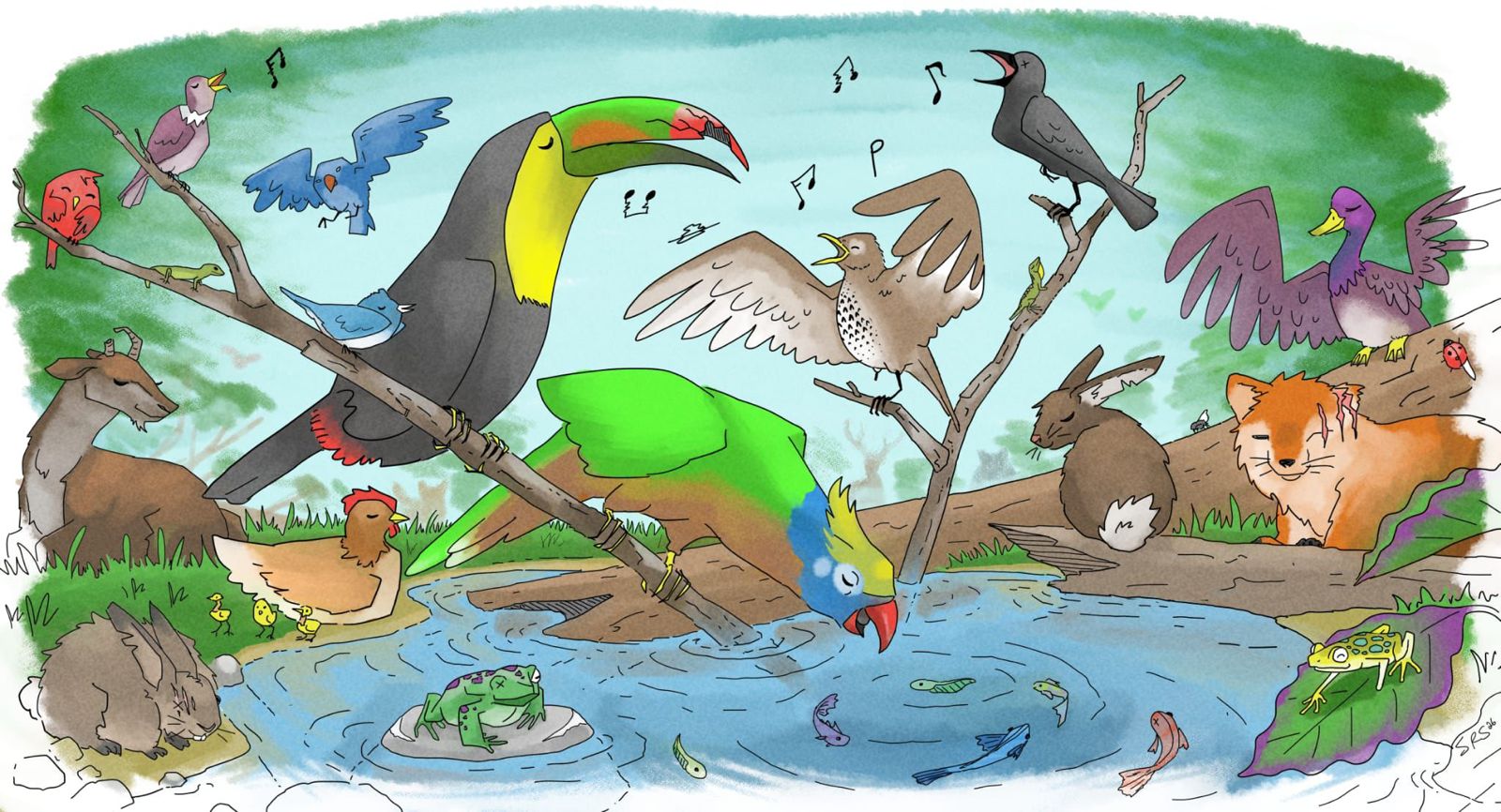
The singing bird was alone, or so he thought. Suddenly, another song sounds nearby. It’s a timid song, barely perceptible over the pond’s breeze, because it comes from another “broken” bird. It’s a toucan, who understood why Zorzal’s song was interrupted just as he was about to join it from far away, because he was also a flock reject. His beak was “broken”. The toucan flies closer to Zorzal, and sings as best as he can, inviting his young counterpart to join his performance. Zorzal feels less lonely, and he loudly sings his feelings. The two birds, destined to be alone, are not so much so.
The melody of two resonates through the woods. Some lonely souls shyly approach the unconventional sound of the two new friends singing. A frog with one eye, multiple one-legged birds and many critters with small deformities caused by the wild nature of the woods join the song. All the ingredients of friendship are the composers of this melody: comfort, understanding, familiarity, trust, and company. The melancholy of the song disappears, because now the “broken” animals feel complete.
Many animals from all over the forest follow the music to its source, and when they find the group, they immediately notice the “flaws”, deciding to continue their journey of survival elsewhere, away from the complications of having a weak link in their groups. But a parrot, colorful and perfect, joins the “broken” song. There’s no flaws in his voice, his feathers or his healthy body. The “broken” birds start noticing the newcomer and become silent, because they don’t think he’s part of the group. With the parrot, they feel it is no longer a group of equals. There’s no understanding; they don’t feel part of the same thing. More and more birds stop singing until it’s only the parrot and the toucan. Zorzal is now deep in thought. He knows how it’s natural to react to unwanted company, but he hesitates. Lots of the “broken” animals fly or walk away, but Zorzal can’t really move. He’s confused, because he’s seen this before, and he doesn’t like it. Zorzal sees himself reflected in the parrot, who joined something beautiful and was now rejected for being different.
But then –– the toucan spreads his wings and starts singing louder. His song still carries the pain of rejection, but it also joyfully invites everyone to join in. Zorzal takes a deep breath and resumes his song, as loud as he can. He wants to mask the rejection of the “broken” animals so that the parrot doesn’t notice, while also inviting them to come back. Zorzal wants everyone to feel welcome. He wants everyone to be near him, because he wants to be near others. Zorzal thinks the laws of nature might see him being alone, but his desire to have friends is stronger. So the society of “broken” animals persists… the song continues and fills the woods with the broken hearts, which are now not so much so.
Because rejection met with rejection, would create a lonely world for all.
Because the differences might be easier to spot, but spotting similarities should be more important.
Because friends are not those who look, feel or think the same way, but those who want to stay together.
Because anyone who wants to sing, should sing. And as more friends join the chorus, and the happier the singing hearts, the song will be the most beautiful.
Deja un comentario